AI-Assisted API Documentation Workflows for a Fintech Platform
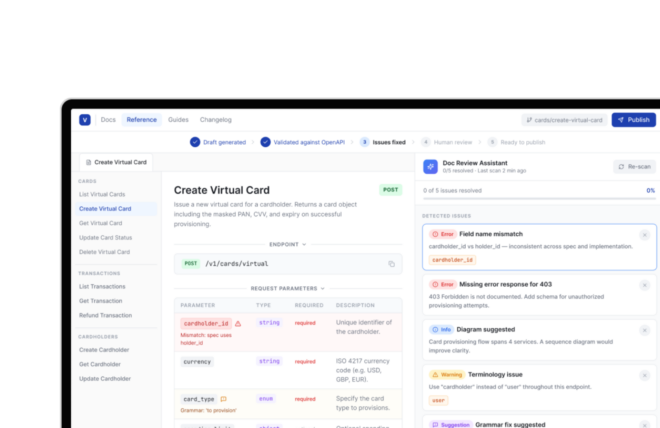
A fintech platform serving banks and financial institutions was losing engineering time to repetitive documentation work, and had no reliable way to keep its API documentation current as the product changed. We audited the knowledge base and built AI-assisted workflows into the team’s existing environment, with engineer approval at every publication point. New pages are now drafted in under five minutes and existing ones fixed in under one, without changing the team’s tools or approval process.
- AI Workforce Automation, AI-Powered Technical Documentation
- 2026
- Industry: FinTech
Initial Task
Description
The сlient is a fintech platform serving banks and financial institutions, whose customers integrate against its APIs. The documentation is how the product gets adopted, and it has to stay accurate as the APIs change.
Nothing kept it accurate except hand work. A fifteen-person engineering team onboarded each new endpoint into the knowledge base, audited existing pages against what the code actually did, and propagated terminology changes across the whole base, while documentation that lagged behind the product made integration harder for the banks building on it.
The сlient asked Touchlane to take the repetition out of that work, on two conditions: the team keeps its existing tools, and nothing reaches publication without a person approving it.
Technology stack


Challenges
Automation that stays inside the existing process
The team had working tools and a working review process, and replacing either was off the table. The automation had to fit into the environment the engineers already used, produce output in the form their process already handled, and leave version history and rollback to the documentation system that already managed them. Anything that required the team to work somewhere else would not have been adopted.
Output that engineers can trust enough to approve
AI that drafts plausible documentation for a payments API is worse than no automation at all, because a reviewer has to check every line. The workflows had to be connected to approved sources of truth rather than generating from general knowledge, so that reviewing a draft took minutes instead of rewriting it.
Control kept with people
In a regulated environment, automation that publishes on its own is a liability. Every workflow had to end at a human decision point, with approval, escalation and an audit trail of what the automation did and who signed it off.
Workflow
Overall Result
Documentation tasks that used to take an engineer 30 to 60 minutes are now prepared by the automation layer in minutes: a draft for a new page in under five, a fix to an existing one in under one, with a few minutes of human review before anything is published. Terminology, naming, diagram coverage, grammar and language quality are more consistent across the API documentation than hand maintenance could keep them.
Nothing about how the team works had to change to get there. The same tools, the same review process, the same version history and rollback, with engineer approval still standing between a draft and a published page.